Language and Power
Aria - by Richard Rodriguez
Teaching Multilingual Children- by Virginia Collier
Teaching Bilinguals, Even if You're Not One! - CUNY NYSIEB
The recurring theme of these articles and videos is the part that language plays in the education of many students. In the article Aria by Richard Rodriguez, Richard speaks about his personal experience as a child learning English as a second language. This article brings to light the harm that a monolingual- English educational approach can have on a persons identity. Rodriguez proposes that one individual cannot have both confidence in their home language and culture while being successful in the public language and culture (English) within our current society. He says, "They do not realize that while one suffers a diminished sense of private individuality by becoming assimilated into public society, such assimilation makes possible the achievement of public individuality." (Rodriguez, 39) The idea that any human has to give up their personal/private identities to be able to succeed in our society is terrible and disheartening.
Up until the recent past students and teachers were expected to speak English only in schools. This created a separation between students and their families, as well as a loss of identity and culture in some cases. In Virginia Collier's article Teaching Multilingual Children, the importance of honoring a student's home language is discussed. When addressing how culturally responsive teaching can improve our educational system Collier says, "the key is the true appreciation of the different linguistic and cultural values that students bring to the classroom." (Collier, page 223) This statement reminds me of Lisa Delpit's article The Silenced Dialogue, where she speaks about the problems that can occur when educators are not understanding or knowledgable of the diversities of their students. Colliers article also addresses language acquisition and the difference between social language vs. academic language. Some educators have the idea that students will "sink of swim" if we throw them into a class of English speaking peers and that language acquisition will occur within a year. This is far from the truth. We must address both social linguistics (such as conversational English) and academic linguistics (content jargon and vocabulary) in different ways. One quote that stuck out to me was, "People untrained in linguistics, particularly politicians, tend to believe that if limited English proficient students can converse with their monolingual English-speaking peers, then these English-language learners can compete with them on equal footing." (Collier, page 225) This statement reminds me of the state testing conversations I have had with other educators, administration and even RIDE. Our MLL students are not given a true chance to show their knowledge with tests that are designed for monolingual English-speakers. Districts that have higher percentages of MLLs typically do not perform as well on the state testing, not because our students are not as "smart", but because our state leaves our MLLs out of the evaluation planning and creation.
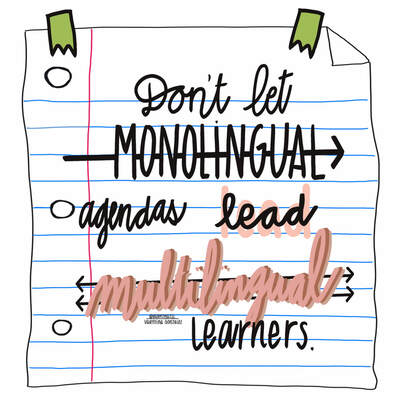
In addition to these two articles, the series Teaching Multilingual Learners- Even if You're Not One! by CUNY-NYS explores how educators can better support their growing MLL populations within their classrooms. In episode 1 of the series the presenter, Sarah Vogel, says that translanguaging is the key to success for our MLLs. Translanguaging is the idea of utilizing ALL of our students linguistic abilities to promote learning of both academia and the English language. Episode 2 of the same series explores the importance of being an advocate for our bilingual, or multilingual, students. While touring an elementary school in Bedford Hills, New York, Sarah Vogel asks different teachers about their experiences with teaching MLLs. During one interview the teacher says, "Having different languages is only going to help them. It is only going to let them go further."(Teaching Multilingual Learners, episode 2) I love this asset-based perspective! We need more educators to look at being multilingual as an advantage and a beautiful gift. When we encourage our students to speak (and read/write) in more than just English, we are validating that other languages are just as powerful/important.
In conclusion, all educators should be trained and/or exposed to linguistics and how to best support our multilingual learners. We must lift up our students for being able to speak not only in their home languages but also acquiring English. When we encourage all of our students to use more than English, we are showing them that it is okay to be themselves and that they do not need to change a large part of their identities to be successful in the game of school.


No comments:
Post a Comment